


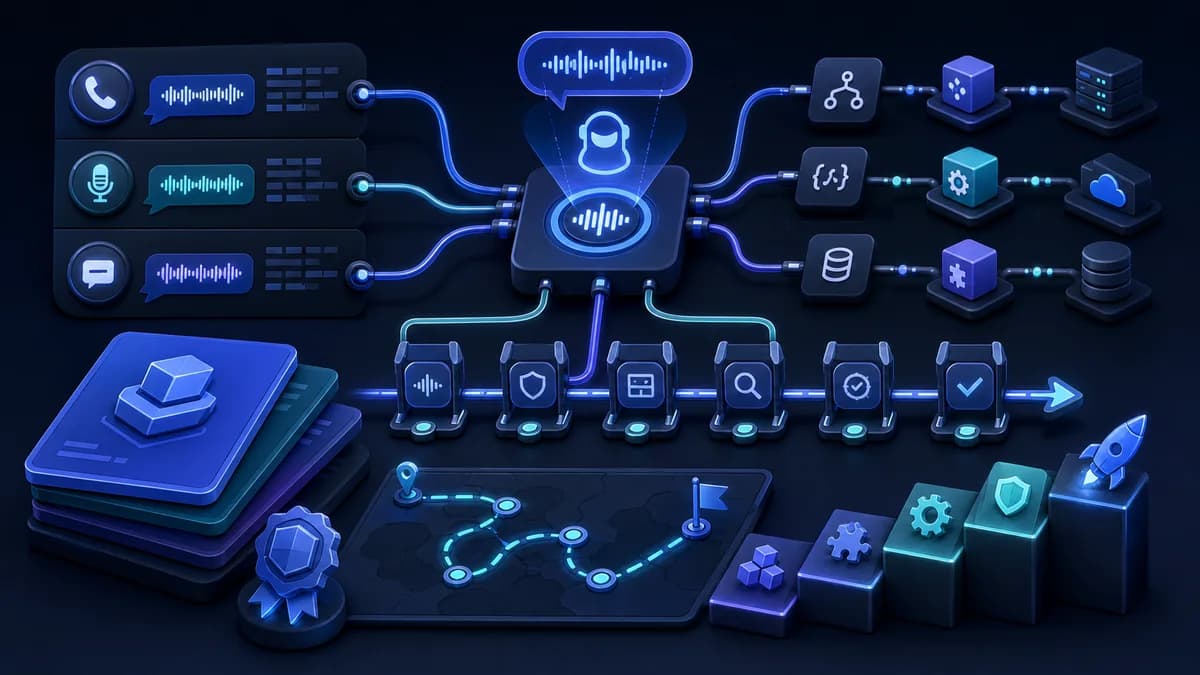
The best agentic AI course is not the one with the most frameworks. It is the one that makes you build a constrained agent, test its decisions, and explain what happens when a tool, model, or retrieval step fails.
Bottom line: Start with the free Hugging Face Agents Course if you want a structured path through agent concepts, multiple frameworks, agentic RAG, and a final project. Use focused DeepLearning.AI short courses when you already know the basics and need a compact module on LangGraph, multi-agent design, or evaluation. Read the Anthropic agent workflow guidance before choosing either path so you do not confuse a deterministic workflow with an agent that needs open-ended decisions.
Best routes by learner goal
| Goal | Best starting route | Why |
|---|---|---|
| First complete agent course | Hugging Face Agents Course | Moves from agent fundamentals through frameworks, agentic RAG, observability, evaluation, and a final project |
| Learn LangGraph after LLM basics | DeepLearning.AI's AI Agents in LangGraph | Focused graph, state, and human-in-the-loop practice without a long catalog |
| Understand multi-agent collaboration | DeepLearning.AI's Multi AI Agent Systems with crewAI | Narrow course for roles, tasks, coordination, and tool use |
| Learn production judgment | Anthropic's Building Effective Agents plus a project | Separates workflows from agents and emphasizes simple, composable patterns |
| Build with an SDK | Official OpenAI Agents SDK documentation plus tests | Best for learners who already understand tools, handoffs, tracing, and guardrails |
These routes are complements, not interchangeable rankings. Hugging Face provides the broadest coherent course path in this shortlist. DeepLearning.AI is useful for targeted gaps. Provider documentation is necessary when you need current SDK behavior, but documentation alone rarely supplies the project sequence or feedback loop of a course.
Prerequisites: do not begin with autonomy
You are ready for agentic AI training when you can already:
- write Python and call an HTTP or model API;
- validate structured output and handle errors;
- use Git and run tests;
- explain basic retrieval or context injection;
- keep credentials out of source code;
- distinguish a product requirement from a model demonstration.
If those skills are missing, start with the AI Agent Developer Learning Path 2026. Agent frameworks compress orchestration code; they do not remove the need to understand state, permissions, retries, and failure review.
What the Hugging Face Agents Course currently covers
The official course page describes a free path from agent fundamentals to building agents with smolagents, LlamaIndex, and LangGraph. Its navigation includes agentic RAG, a final project to create and test an agent, and bonus material on function-calling fine-tuning, observability, and evaluation. The course also distinguishes a self-audit path from a certification process.
That makes it the strongest first choice for learners who want one visible sequence and are willing to compare frameworks rather than memorize one abstraction. Its breadth is also the main risk: finish one framework project before sampling every unit. A portfolio with one small, inspectable agent is stronger than three unfinished notebooks.
When a short course is the better choice
DeepLearning.AI's official short-course catalog is better used as modular training. AI Agents in LangGraph is appropriate when you need graphs, state, persistence, and human checkpoints. Multi AI Agent Systems with crewAI is relevant when your design truly benefits from specialized roles and coordination. Evaluating AI Agents belongs after you have a working system and repeatable tasks to score.
Do not stack short courses as substitutes for a capstone. For every module, add one artifact to the same project: a state diagram, a permission table, a trace, an evaluation set, or a failure report.
Curriculum gate: seven things the course must teach
1. Workflow before agent
The learner should be able to choose between a fixed pipeline, router, parallel workflow, evaluator loop, and open-ended agent. Anthropic's official guidance is useful here because it starts from simple, composable patterns instead of treating maximum autonomy as the goal.
2. Tool contracts and permissions
Every tool needs a clear input schema, output shape, allowed scope, timeout, and denied action. A course that demonstrates tool calling but never discusses credentials or approval gates is incomplete.
3. State and recovery
The project should persist enough state to resume safely, avoid repeating side effects, and explain what happens when a step fails halfway through.
4. Retrieval and memory boundaries
Agentic RAG should include citations, bad retrieval cases, and rules for what is not stored. “Memory” is not automatically a user benefit.
5. Evaluation
Demand a task set with expected outcomes, tool-use checks, refusal cases, and regression thresholds. A judge model can assist, but the course should also show human review and deterministic assertions.
6. Observability and cost
The learner should inspect traces, latency, token or model use, tool errors, and retry behavior. Pretty final answers are not enough evidence.
7. Safety and human control
The agent needs explicit approval before consequential writes, a safe-stop path, and an escalation story when confidence is low or a tool denies access.
The capstone that proves the course worked
Build a bounded support-triage or repository-maintenance agent with three to five allowed tools. It should produce:
- a README naming the user problem and non-agent baseline;
- a diagram of states, tools, and approval points;
- typed tool schemas and denied actions;
- a 25-case evaluation set including edge and adversarial cases;
- traces for a success, a tool denial, a retrieval miss, and a model failure;
- a cost and latency note;
- a human review checklist and rollback or safe-stop plan.
The final project should be reviewable without running a paid service. Screenshots, saved traces, fixture data, and a short demo make the evidence durable.
How this guide differs from nearby CourseFacts pages
Use Best AI Agent Framework Courses 2026 when the main decision is which orchestration framework to study. Use Best LLM and AI Agent Courses 2026 for a broader LLM-app course shortlist. This page is specifically about course paths that teach agentic decision loops, tools, state, evaluation, and control.
Course purchase and certificate caveats
The Hugging Face path is presented as free on its official page. DeepLearning.AI course access and certificate terms can change by course and account context. Verify current access, certificate, refund, and subscription conditions on the provider page before paying or enrolling.
A course certificate is evidence of completion under that provider's rules. It is not proof that an agent is safe, useful, or production-ready. The capstone and evaluation artifacts should carry that claim.
Related guides
- AI Agent Developer Learning Path 2026
- Best AI Agent Framework Courses 2026
- Best AI Agent Evaluation Courses 2026
- Best Courses for Learning MCP and AI Agent Tooling 2026
FAQ
Should I learn LangGraph, crewAI, or smolagents first?
Learn one after you can describe the workflow without framework vocabulary. LangGraph fits explicit state and control, crewAI emphasizes role-based collaboration, and smolagents offers a compact Hugging Face path. The project requirements matter more than the first library.
Do I need machine learning theory?
You need enough model and evaluation literacy to understand uncertainty, context limits, and quality measurement. You do not need to train a foundation model before building a constrained tool-using agent.
Is a multi-agent project better for a portfolio?
Only when multiple roles solve a real coordination problem. One reliable agent with clear tools, tests, and human control is stronger than a theatrical team of agents with no evaluation.
Sources and methodology
CourseFacts reviewed the Hugging Face AI Agents Course, DeepLearning.AI AI Agents in LangGraph, DeepLearning.AI Multi AI Agent Systems with crewAI, Anthropic Building Effective Agents, and the OpenAI Agents SDK documentation on 2026-07-14. Official pages support curriculum and workflow descriptions, not job outcomes or universal framework rankings.
The links above are editorial references, not disclosed affiliate or sponsored placements.